

What Is KYC? Why Crypto Apps Ask for Your ID
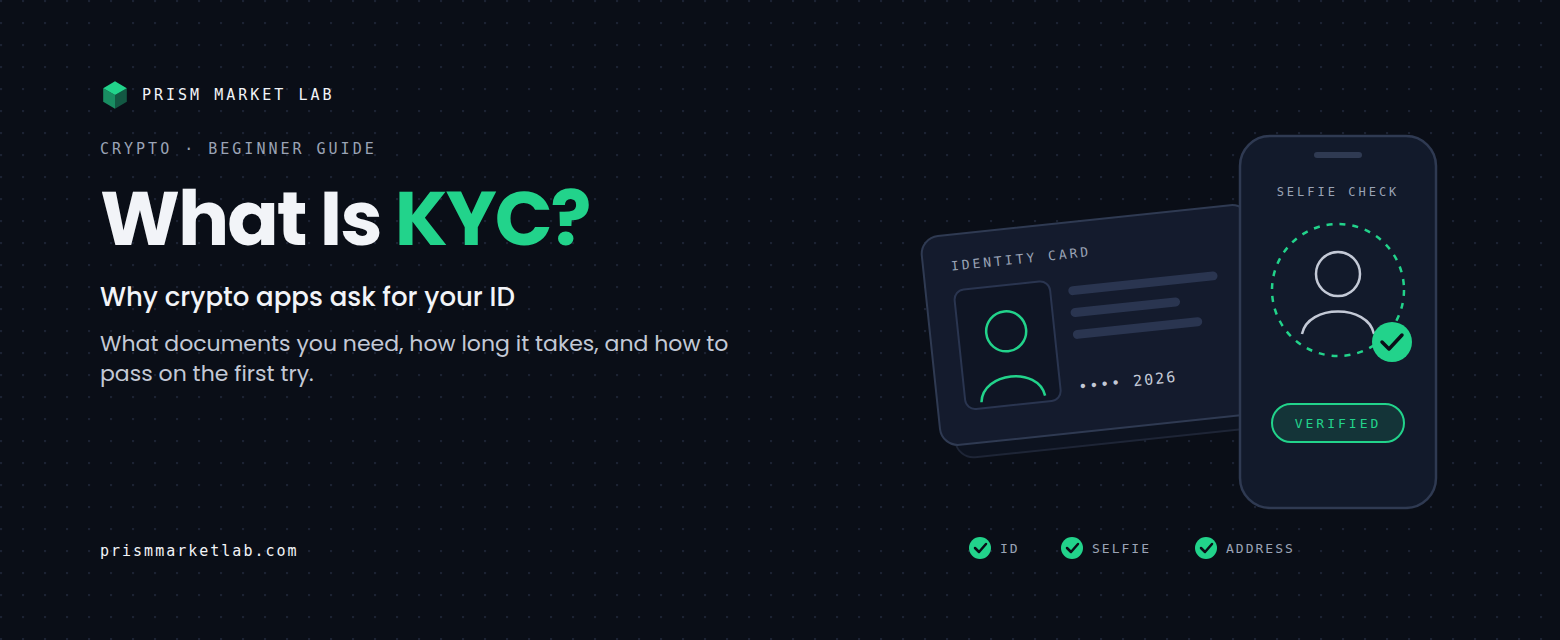
Every regulated crypto app asks for your ID before you can deposit. Here's what KYC is, why it exists, what happens to your data, and simple tips to get verified on the first try.
KYC stands for "Know Your Customer." It's the identity check regulated financial companies, including crypto exchanges and crypto card providers, must do before you can use their services. You usually upload an ID document and a selfie, and sometimes a proof of address. It exists to stop fraud, money laundering and stolen identities, and it usually takes from a few minutes to a day.
Key Takeaways
- KYC is a legal requirement for regulated crypto companies in most countries, not a choice they make.
- Most rejections come from small, fixable problems: blurry photos, cut-off corners, or names that don't match.
- A platform that promises "no KYC, ever" for large amounts is a risk sign, not a feature.
What Does KYC Mean?
KYC means a company must confirm that you are a real person and that you are who you say you are. Banks have done this for decades. When crypto became part of the financial system, the same anti-money-laundering (AML) rules started to apply to crypto exchanges, wallets offered by companies, and crypto card issuers.
In Practice, KYC Answers Three Questions:
- Are you a real person? (your selfie or video check)
- Is this really your identity? (your ID document)
- Are you allowed to use this service? (your country, age, and whether you appear on sanctions lists)
Why Do Crypto Apps Need Your ID?
It can feel intrusive, especially since early crypto was built around privacy. But there are real reasons:
- The law requires it. Regulators around the world, guided by international anti-money-laundering standards, require licensed crypto companies to verify customers. In the EU, for example, the MiCA rules and the "travel rule" for crypto transfers now apply. Companies that skip KYC risk losing their licence.
- It protects you. Verified accounts are harder for criminals to open in your name, and if your account is hacked, support can confirm you are the real owner.
- It keeps the platform safer. Fewer fraudsters and money launderers means fewer frozen funds, fewer bank partners pulling out, and a more stable service for everyone.
- It unlocks features. Higher limits, bank withdrawals and crypto cards usually require full verification.
What documents will you need? Requirements differ by company and country, but a typical KYC check asks for:
- A government-issued photo ID: passport, national ID card, or sometimes a driving licence. It must be valid, not expired.
- A selfie or short video ("liveness check"), where you may be asked to turn your head or blink. This proves a real person is present.
- Proof of address (for some services or higher limits): a recent bank statement, utility bill or government letter, usually from the last 3 months, showing your name and address.
- Source of funds information (for larger amounts): a few questions about your job or where your money comes from, or documents like a payslip.
How Long Does KYC Take?
Many checks are automatic and finish in minutes. If something needs a manual review, it can take from a few hours to a few business days. Busy periods, such as a big market rally when many people sign up at once, can slow things down.
Why KYC Gets Rejected (and How to Fix it)
After helping many users through verification, the same problems appear again and again. Almost all are easy to avoid:
- Blurry or dark photos. Take pictures in daylight or good light, on a plain background, with no glare on the document.
- Cut-off edges. All four corners of the ID must be visible.
- Name mismatch. Your name must match exactly across your account, ID and proof of address, including middle names. If your bank card has a shortened name, that can cause problems later with deposits.
- Expired documents. Check the expiry date before you start.
- Wrong document type. Some services don't accept driving licences or residence permits from certain countries. Check the list first.
- Old proof of address. Usually it must be from the last 3 months and show your full name and the same address you entered.
- Using a screenshot or photocopy. Upload a photo of the original document, not a scan of a scan.
- VPN or location mismatch. Signing up from a different country than your documents can trigger extra checks or rejection.
- Unsupported country. Some services aren't available everywhere. Check before you start.
Tip: if you're rejected, read the reason carefully, fix that one thing, and resubmit. If no reason is given, contact support through the official app or website. Never through someone who messages you first.
What Happens to Your Data?
This is a fair question. Regulated companies must store KYC data securely and keep it for a period set by law, often several years after you close your account. Before you upload documents:
- Check the company is real and regulated in its home country.
- Read the privacy policy to see who processes your data. Many companies use specialist identity-verification providers.
- Only upload documents inside the official app or website. Never send ID photos by email, Telegram or WhatsApp.
If a "support agent" asks you to send your passport photo in a chat, it's a scam to steal your identity.
What About "No-KYC" Platforms?
Some platforms advertise that you can trade without verification. Decentralised exchanges, where you trade directly from your own wallet, often don't require KYC because no company holds your money. But for centralised platforms that hold your funds, "no KYC" usually means they are not licensed where you live.
The Risks:
- Your funds can be frozen without warning, and there may be no one to complain to.
- The platform may suddenly block your country or shut down.
- You may still be asked for KYC later, when you try to withdraw a large amount.
- Using unlicensed services may break local rules.
For beginners, a regulated platform with proper KYC is the safer choice.
KYC for Crypto Cards
Crypto cards run on Visa or Mastercard and usually have a licensed card-issuing partner. That means KYC is required, often with the same steps as an exchange. Some cards add extra checks for higher spending limits. If a crypto card promises no verification at all, treat it as a red flag.
Frequently Asked Questions
Is KYC Safe?
On a regulated platform, it is generally safe. Companies must protect your data by law. Only upload documents inside the official app or website.
Can I Use Crypto Without KYC?
You can use a self-custody wallet and decentralised apps without KYC, but buying crypto with normal money on a regulated exchange requires it.
Why was My KYC Rejected?
Usually blurry photos, cut-off document edges, a name mismatch, or an expired or unsupported document. Fix the issue and resubmit.
How Long does KYC Verification Take?
Often a few minutes; manual reviews can take hours or a few business days.
Do I need to redo KYC?
Sometimes. Companies may ask you to update documents when they expire, when rules change, or when you request higher limits.
Bottom Line
KYC is the identity check that lets regulated crypto companies operate legally and keep fraud out. It takes a few minutes if you prepare: a valid ID, good light, matching names, and a recent proof of address. Be wary of anyone asking for your documents outside the official app, and of platforms that promise you'll never need to verify.
This article is for information only and is not legal advice. Requirements differ by country and provider.