How Do Crypto Cards Work? A Simple Guide for 2026
A crypto card lets you spend crypto anywhere Visa or Mastercard is accepted, and the shop never touches crypto. Learn how it works step by step, which fees to watch, who holds your coins, and how to choose your first card.
Short answer: A crypto card is a normal-looking Visa or Mastercard debit card that lets you spend your crypto in any shop that accepts cards. When you pay, the card provider turns your crypto into regular money in the background, so the shop receives dollars or euros as usual. In 2026, most of these cards are funded with stablecoins.
Key takeaways:
- Shops do not need to accept crypto. The card provider converts it for them.
- Paying with stablecoins usually costs less than paying with Bitcoin or other volatile coins.
- The biggest choices are who holds your coins (custodial or self-custodial), the fees, and how spending crypto is taxed where you live.
What is a crypto card?
A crypto card is a payment card, usually debit or prepaid, linked to a crypto balance instead of a bank account. It runs on the same networks as your normal card, Visa or Mastercard. You can tap it in a café, add it to Apple Pay or Google Pay, shop online, and in many cases withdraw cash from an ATM.
These cards are growing fast. Visa reported more than 160 stablecoin-linked card programs worldwide in September 2026, and about 90% of crypto card transactions run on Visa's network.
How does a crypto card work, step by step?
Here is what happens in the few seconds after you tap your card:
- You pay $20 for lunch with your crypto card.
- The shop's terminal asks the card network (Visa or Mastercard) to approve a normal $20 card payment.
- The card provider checks your balance in crypto or stablecoins.
- The provider sells or uses about $20 of your crypto and sends dollars through the card network.
- The shop receives $20 in its normal bank account. It never touches crypto.
From the shop's side, nothing is different. From your side, your crypto balance goes down by the amount of the purchase plus any fees.
Why most crypto cards now use stablecoins
If you pay with Bitcoin, two problems appear. First, its price changes, so you never know exactly how much of your Bitcoin a coffee will cost. Second, the provider must convert it, which usually adds a fee.
Stablecoins such as USDC and USDT are designed to stay at $1, so a $20 purchase uses about 20 coins. Many providers charge little or nothing to spend stablecoins and more to spend volatile coins. For example, Coinbase's card has been reported to charge no conversion fee on USDC but 2.49% on other crypto. Fees change, so always check the provider's current fee page.
That is why the market increasingly talks about stablecoin cards rather than crypto cards. If stablecoins are new to you, read.
What Are Stablecoins?
Custodial vs self-custodial: who holds your coins?
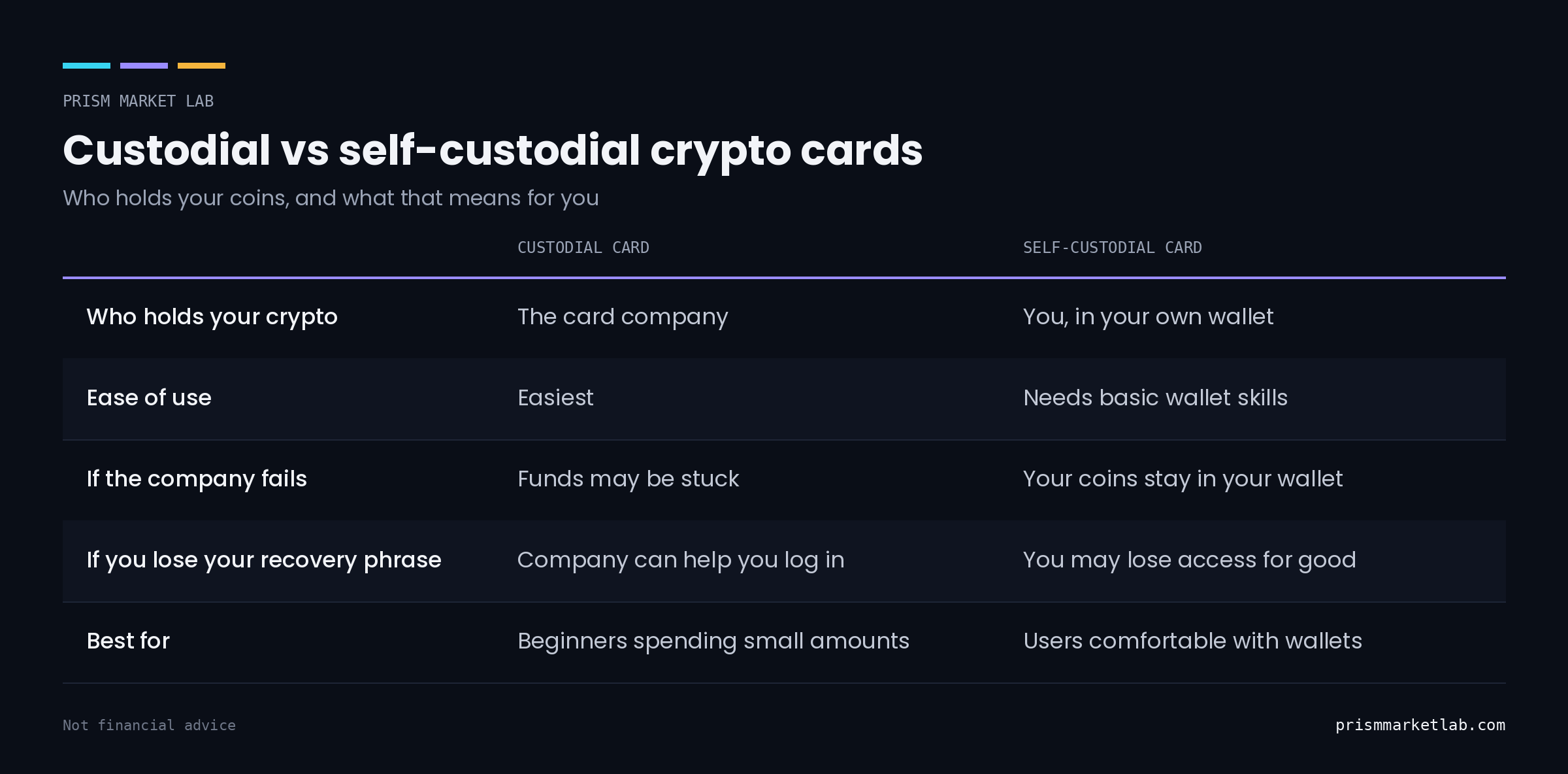
This is the most important choice, and many beginners miss it. Custodial cards: you send your crypto to the card company's app, and the company holds it for you. It is simple: you log in like a banking app, and support can help if something goes wrong. But if the company has problems, freezes your account, or fails, your money can be stuck.
Self-custodial cards: your crypto stays in a wallet you control, and the card only takes what it needs at the moment you pay. You keep more control, but you are responsible for your wallet, your recovery phrase and your security.
A simple rule: keep only what you plan to spend in the next month or so on any card, and store the rest somewhere safer.
What fees do crypto cards charge?
Fees vary a lot between cards. Look for these before you sign up:
- Conversion or spread fee — the cost of turning crypto into dollars or euros. Often lower or zero for stablecoins.
- Foreign exchange fee — when you pay in a different currency from your card balance.
- ATM fee — many cards give a few free withdrawals a month, then charge.
- Top-up fee — moving money onto the card, including blockchain network fees.
- Card issuance or monthly fee — some premium cards charge for metal cards or higher rewards.
- Inactivity fee — rare, but check the small print.
One area where stablecoin cards often shine is travel. Many traditional banks charge around 2–3% for foreign currency payments, while some stablecoin cards charge less. Compare the full cost for the way you actually spend. We break down every fee in Crypto Card Fees Explained.
Do you pay tax when you spend crypto with a card?
In many countries, yes, possibly. When you spend Bitcoin or another coin, you are usually treated as selling it. If it went up in value since you bought it, you may owe tax on that gain, even on a small purchase. Every coffee can become a tiny taxable event.
Stablecoins make this simpler because their price barely moves, so gains are usually tiny or zero. Rules differ by country, so keep your transaction history (most card apps let you export it) and check with a local tax adviser.
Are crypto cards safe?
The card part is as safe as a normal debit card: you get chip and PIN, contactless limits, and usually card freezing and two-factor login in the app. The extra risks come from crypto:
- Provider risk with custodial cards, if the company runs into trouble.
- Regional changes — card programs sometimes close in certain countries, so you may need to move funds quickly.
- Scams — fake card apps and "pre-approved card" offers that ask you to send crypto first. Only download apps from the official website or app store, and never share your recovery phrase.
- Volatility — if you keep Bitcoin on the card, your spending power changes with its price.
All legitimate crypto cards require identity verification (KYC). A card that promises no checks at all is a red flag.
How to choose your first crypto card: a checklist:
- Is it available in your country? Many cards serve only certain regions.
- Custodial or self-custodial? Pick what matches your skills.
- Which coins can you spend? Make sure your preferred stablecoin is supported.
- What are the real fees? Conversion, FX, ATM and top-up.
- Cashback or rewards? Check if rewards are paid in a volatile token and whether you must lock up funds to get them.
- Apple Pay / Google Pay support? Useful for everyday spending.
- Is the company regulated? Check its licence and its banking or card-issuing partner.
- How good is support? Read recent user reviews before you deposit.
See our comparison in Best Crypto Cards in 2026.
How to get started: 5 steps
- Choose a card using the checklist above.
- Download the official app and verify your identity.
- Order a virtual card (often instant) and, if you want, a physical card.
- Top up with a small amount of stablecoins first, for example $20–50.
- Make a small test purchase, check the fee in the app, then use it normally.
Frequently Asked Questions
Do shops need to accept crypto for a crypto card to work?
No. The shop receives normal money through Visa or Mastercard. The card provider handles the conversion.
Can I withdraw cash with a crypto card?
Usually yes, at ATMs that accept Visa or Mastercard. Check the free withdrawal limit and the fee after that.
Is a crypto card a credit card?
Most are debit or prepaid cards: you spend money you already hold. A few crypto credit cards exist, but they are less common.
Which is better to spend, Bitcoin or stablecoins?
For everyday spending, stablecoins are usually simpler and cheaper, and they cause fewer tax headaches.
Can I use a crypto card abroad?
Yes, anywhere your card network is accepted. Compare the FX fee with your bank card before you travel.
Are crypto cards anonymous?
No. Legitimate cards require identity verification, just like a bank card.
Bottom line
A crypto card lets you spend crypto anywhere cards are accepted, without the shop ever touching crypto. For most beginners, a stablecoin-funded card with clear fees, a regulated provider and only a small balance on it is the simplest way to start.
This article is for information only and is not financial or tax advice. Crypto assets are risky and you can lose money.