What Are Stablecoins? A Simple Guide for Beginners
Stablecoins are crypto tokens built to stay at $1. Learn how they work, the three main types, the real risks, what the new US rules mean for you, and how to buy your first one safely.
A stablecoin is a type of cryptocurrency designed to keep a steady price, usually $1. You get the speed of crypto, 24 hours a day and across borders, without the wild price swings of Bitcoin. Most stablecoins stay at $1 because the company behind them holds real dollars or short-term US government bonds for every coin.
Key takeaways:
- Stablecoins aim to be worth exactly $1, so you can send and hold value in crypto without the usual price swings.
- The two biggest, USDT and USDC, held about 84% of the market in mid-2026.
- They are useful but not risk-free. A stablecoin is only as safe as its reserves and the company that manages them.
What is a stablecoin?
A stablecoin is a digital token that lives on a blockchain, like Bitcoin or Ethereum, but is built to hold a fixed value. Most are tied, or "pegged", to the US dollar. One USDC should always be worth about $1, today, next week and next year.
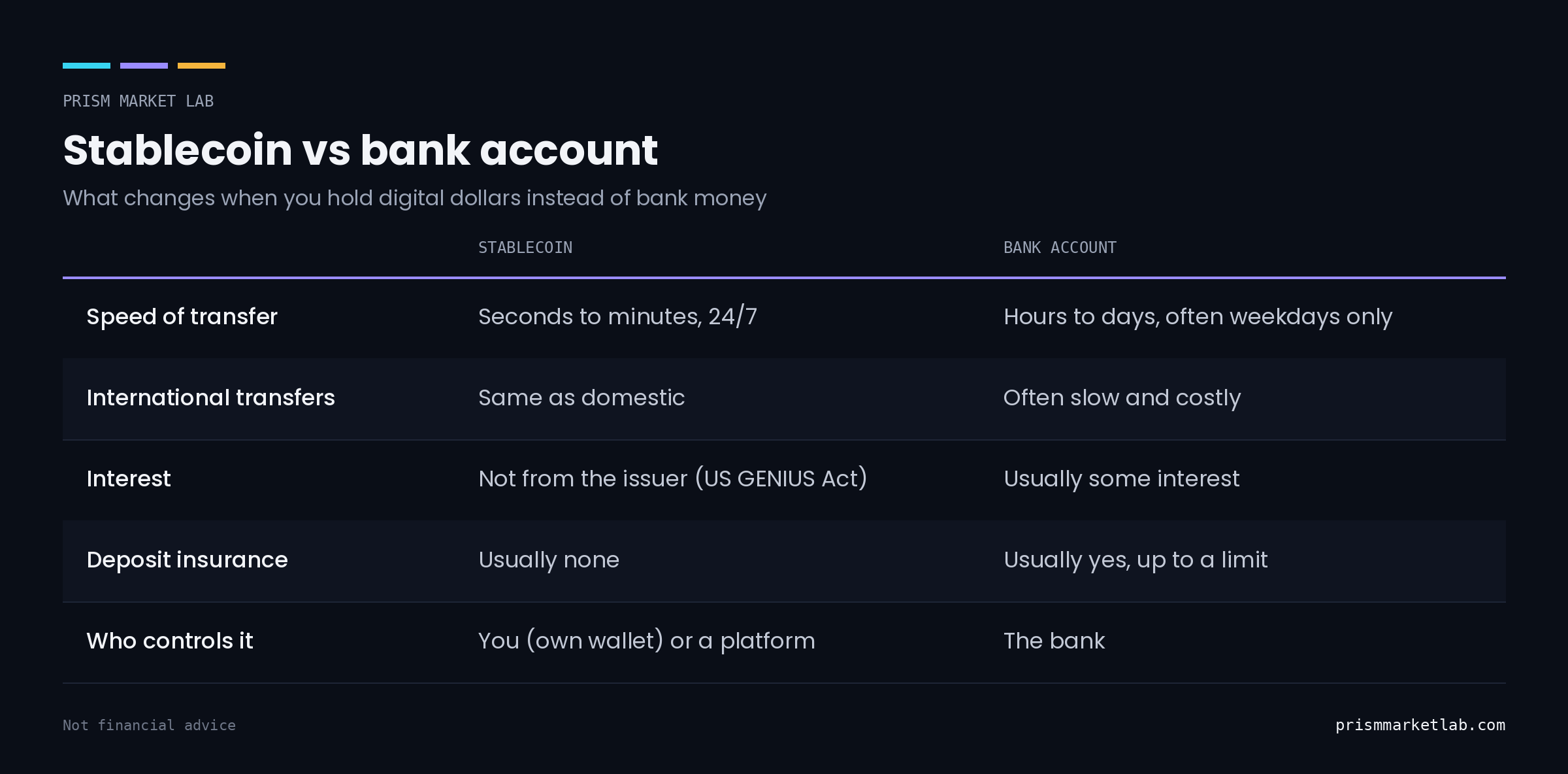
Think of it as a digital dollar you can send to anyone with a crypto wallet. The transfer can arrive in seconds or minutes, any day of the week, often for a fee of a few cents.
Stablecoins are now a big part of crypto. The total value of all stablecoins was about $308 billion in August 2026, after a record of about $322 billion in May 2026.
Why do stablecoins exist?
Regular cryptocurrencies move a lot. Bitcoin can rise or fall 5% in a day. That is exciting for traders but hard if you just want to pay someone, save, or park money between trades.
Stablecoins solve this. You can use them to:
- Move money between crypto exchanges without converting back to your bank's currency each time.
- Send money abroad quickly, often cheaper than a bank transfer.
- Hold dollars if you live in a country where your local currency loses value fast.
- Pay with a crypto card at normal shops (see our guide to how crypto cards work).
- Take a break from trading without leaving crypto.
How do stablecoins keep a $1 price?
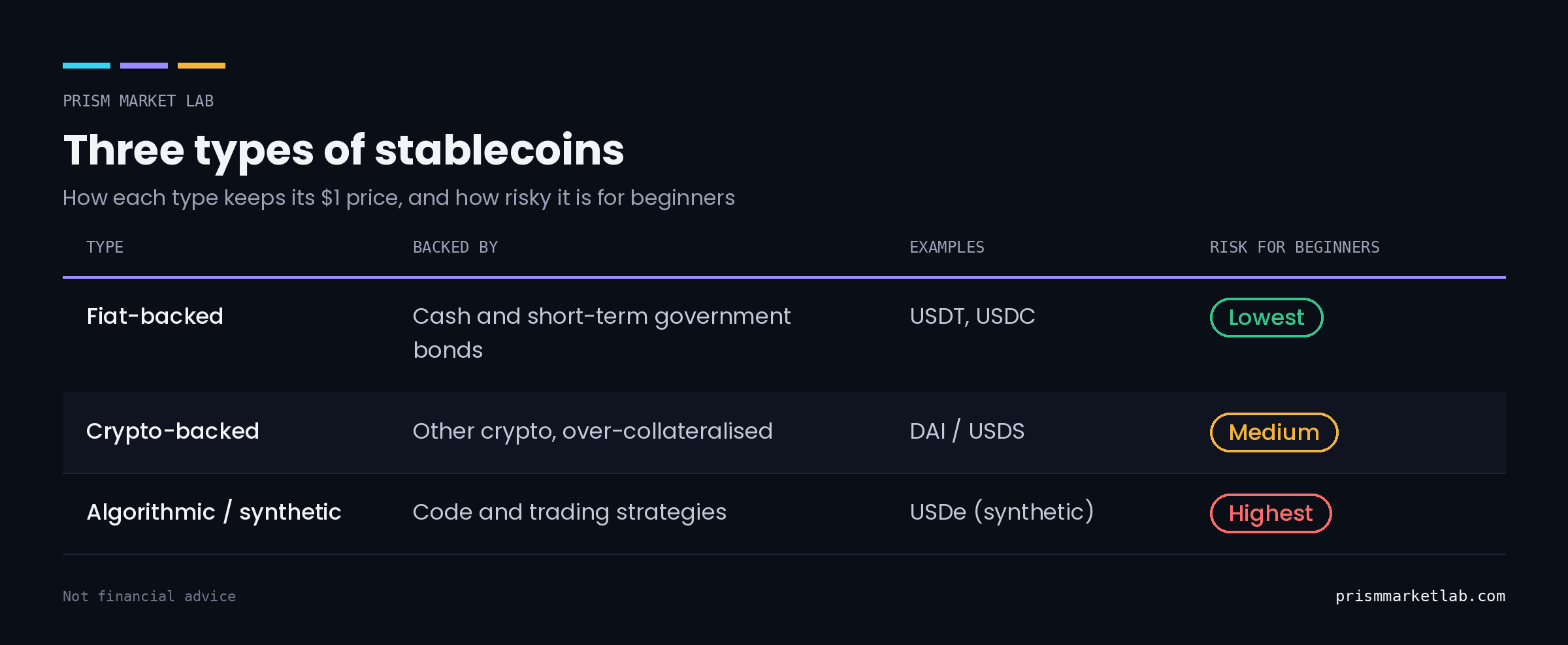
The key word is reserves: the assets that back each coin. There are three main ways stablecoins hold their value.
1. Backed by cash and government bonds (fiat-backed)
The issuer, a company like Tether or Circle, keeps $1 in cash or short-term US Treasury bills for every coin it creates. When you hand back a coin, the issuer can give you $1 and destroy the coin. Because anyone large enough can swap 1 coin for $1, the price stays close to $1. USDT and USDC work this way. Under the US GENIUS Act, regulated issuers must hold this kind of one-to-one backing.
2. Backed by other crypto (crypto-backed)
Some stablecoins are backed by other cryptocurrencies locked in a smart contract, a program on the blockchain. Because crypto prices move, they usually hold more collateral than the coins are worth, for example $150 of Ether for every $100 of stablecoins. DAI, now part of the Sky ecosystem, is the best-known example.
3. Kept stable by code (algorithmic or synthetic)
These use trading strategies or automatic rules instead of simple reserves. They can offer extra features but carry more risk. The most famous failure was TerraUSD (UST), an algorithmic stablecoin that collapsed in May 2022 and wiped out billions of dollars. US stablecoin law now effectively rules out purely algorithmic designs for regulated payment stablecoins.
What are the most popular stablecoins?
The market is dominated by two coins. At the end of June 2026, Tether (USDT) held about 60% of all stablecoin value and USD Coin (USDC) about 24%.
- USDT (Tether) — the largest and most traded, especially on international exchanges and in emerging markets.
- USDC (Circle) — popular with US companies and regulated apps; Circle publishes regular reserve reports.
- DAI / USDS (Sky) — the best-known decentralised option, backed by crypto.
- Newer coins — such as USD1 and others, often launched with big partners. Smaller coins can be useful but have less history.
We compare the two leaders in detail in USDT vs USDC: Which Stablecoin Is Better for You?
Are stablecoins safe?
Stablecoins are designed to be stable, but they can fail. Before you hold a meaningful amount, understand these risks:
- Losing the peg ("depegging"). A stablecoin can briefly trade below $1 if people doubt its reserves. In March 2023, USDC dropped to about 88 cents for a weekend when part of its reserves sat in Silicon Valley Bank, which failed. It recovered once the money was safe.
- Issuer risk. With fiat-backed coins, you trust the company to really hold the reserves and let people redeem.
- Platform risk. If you keep stablecoins on an exchange and the exchange fails or freezes withdrawals, you may lose access.
- Smart contract risk. Crypto-backed coins depend on code, which can have bugs or be hacked.
- Freezing. Most fiat-backed issuers can freeze coins at specific addresses, for example after a court order or sanctions.
- No deposit insurance. Stablecoins are not bank deposits. In most countries, government deposit insurance does not cover them.
How to protect yourself: stick to large, established stablecoins; spread larger amounts across more than one coin or platform; use well-known regulated exchanges; and for long-term holding, consider a wallet you control.
What do the new US laws mean for you?
In July 2025 the US passed the GENIUS Act, its first federal law for payment stablecoins. In simple terms:
- Regulated issuers must back coins one-to-one with cash or short-term government bonds.
- They must follow anti-money-laundering and sanctions rules.
- Issuers are not allowed to pay you interest just for holding their stablecoin.
The second big bill, the CLARITY Act, would set rules for the wider crypto market. It passed the House of Representatives in 2025, but a key Senate vote failed 49–50 on September 15, 2026, so it is not law yet. If you live outside the US, other rules may apply, such as the EU's MiCA regulation. Always check which rules cover the platform you use.
Can you earn interest on stablecoins?
Sometimes, but carefully. Issuers cannot pay interest under the GENIUS Act, yet some exchanges and apps offer "rewards", and crypto lending or DeFi platforms offer yield. Higher yield always means higher risk: the platform could fail, a smart contract could be hacked, or the reward could change overnight. If an offer sounds like a savings account with a much higher rate, ask where that money comes from. Read more in Stablecoin Yield Explained.
How to buy your first stablecoin: 5 steps
- Choose a regulated exchange available in your country.
- Create an account and verify your identity (KYC). This usually takes minutes to a day.
- Deposit money by bank transfer or card. Bank transfer is usually cheaper.
- Buy USDC or USDT. Check the fee and the exact amount you will receive before you confirm.
- Decide where to keep it. Leave small amounts on the exchange for trading, or move larger amounts to a wallet you control. Always double-check the network (for example Ethereum, Tron or Solana) before sending; sending on the wrong network can mean losing the coins.
Start small. Send yourself a test transaction first.
Stablecoins VS a Bank Account
Frequently Asked Questions
Is a stablecoin the same as a digital dollar?
Not exactly. A stablecoin is issued by a private company, not a central bank. It aims to be worth $1, but it is only as reliable as its reserves and issuer.
Which stablecoin is best for beginners?
Most beginners start with USDC or USDT because they are the largest and most widely accepted. Compare them in USDT vs USDC.
Can a stablecoin go to zero?
Yes, it can happen. TerraUSD collapsed in 2022. Large reserve-backed stablecoins have a much stronger track record, but no stablecoin is risk-free.
Do I pay tax on stablecoins?
In many countries, swapping or spending crypto can be a taxable event, even with stablecoins. Rules differ by country, so check with a local tax adviser.
Can I spend stablecoins in shops?
Yes. A stablecoin-linked crypto card lets you pay anywhere that accepts Visa or Mastercard.
Are stablecoins legal?
In most major markets, yes, and many now have specific laws, such as the GENIUS Act in the US and MiCA in the EU. Some countries restrict them, so check your local rules.
Bottom line
Stablecoins give you the speed and reach of crypto with a steady $1 value. They are useful for trading, sending money and spending with a card. Choose large, well-backed coins, keep them on trusted platforms or in your own wallet, and remember they are not bank deposits.
This article is for information only and is not financial advice. Crypto assets are risky and you can lose money.