

How to Avoid Crypto Scams: 12 Warning Signs
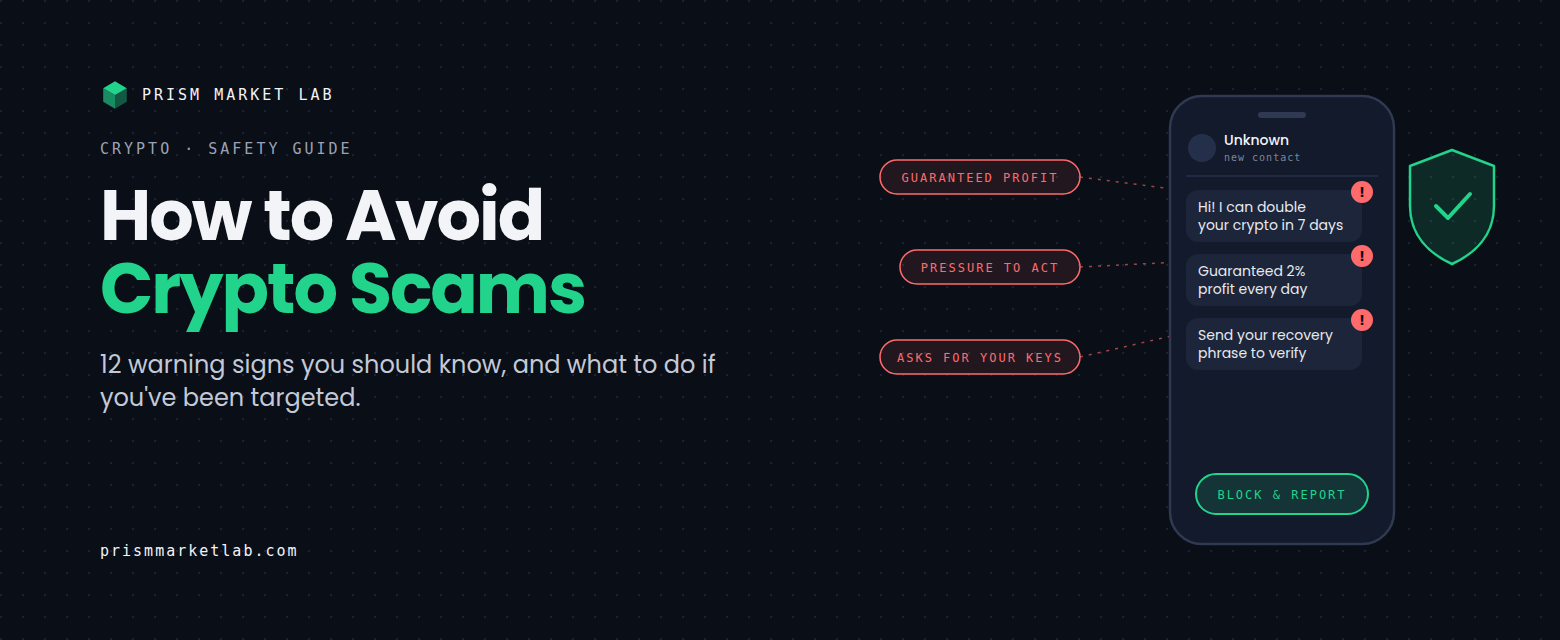
Most crypto losses don't come from price crashes; they come from scams. Learn the 12 warning signs, how the most common scams work in 2026, and exactly what to do if you've been targeted.
Most crypto scams follow the same pattern: someone you don't know contacts you, builds trust, promises easy or guaranteed profits, and then asks you to send crypto or share access to your wallet. If anyone pressures you to move money quickly, promises returns, or asks for your recovery phrase, stop. It's almost certainly a scam.
Key Takeaways
- No real investment guarantees returns. "Guaranteed" is the clearest warning sign there is.
- Real companies never ask for your recovery phrase, never ask you to "verify" your wallet, and never contact you first on WhatsApp or Telegram.
- Crypto transfers usually can't be reversed. Prevention is the only reliable protection.
Why Crypto Scams Are So Common
Crypto moves fast, works across borders and, once sent, usually can't be reversed. There is no bank to call to cancel the transfer. Scammers know this. They also know many people are new to crypto and don't yet recognise what normal looks like. The good news: almost every scam uses the same few tricks. Once you know them, they are surprisingly easy to spot.
The 12 Warning Signs
- Guaranteed or very high returns. "Earn 2% a day," "double your Bitcoin in a week," "no risk." Real markets go up and down. Anyone promising certainty is lying.
- Someone you don't know contacts you first. A friendly stranger on Instagram, a wrong-number text that turns into a chat, a match on a dating app who talks about investing. This is how the most damaging scams start.
- Pressure to act now. "Only today," "spots are limited," "the price will jump tomorrow." Urgency stops you from thinking and checking.
- A request for your recovery phrase or private key. Your 12–24 recovery words are the master key to your wallet. Anyone who asks for them, for any reason, wants to steal your coins.
- A platform you can only find through one person. If the trading app or website was recommended by someone you met online, and you can't find independent reviews or a regulator listing, it's likely fake.
- You can deposit but not withdraw. Fake platforms show big gains on screen, then invent "taxes," "fees" or "verification deposits" when you try to withdraw. Paying them never releases your money.
- Celebrity or company endorsements in ads. Scammers use fake videos, AI-generated voices and edited photos of famous people "recommending" a platform. Real celebrities don't promote secret investment apps in ads.
- Messages from "support" that you didn't contact. Real exchanges don't DM you first. Fake support accounts reply to people who complain publicly on X or Telegram, then ask for login details or a "wallet verification."
- Links that look almost right. Phishing sites copy real exchanges with tiny changes in the address, like an extra letter or a different ending. Always type the address yourself or use a bookmark.
- "Connect your wallet to claim a reward." Fake airdrop and mint sites ask you to connect your wallet and sign a transaction. That signature can give them permission to empty it.
- Payments asked for in crypto only. A "government official," "tax office" or "delivery company" asking you to pay in Bitcoin or USDT is a scam. Real authorities don't work this way.
- Someone offering to recover your lost crypto, for a fee. After people lose money, "recovery experts" appear promising to get it back. They take a fee and disappear. This is often the second scam on the same person.
The Most Common Crypto Scams Right Now
Romance and "pig butchering" scams. The scammer builds a friendship or relationship over weeks, then casually mentions how much they earn on a trading platform. They help you open an account on a fake site, show you fake profits, and encourage bigger deposits. When you try to withdraw, the money is gone.
Fake trading groups. Telegram or WhatsApp groups full of "members" posting winning trades, run by a "professor" or "analyst." Most members are fake accounts. The goal is to move you onto a platform they control.
Phishing and fake apps. Copies of real exchange websites and wallet apps that steal your login or recovery phrase. Some appear as sponsored search results above the real site. Address poisoning. Scammers send you a tiny transaction from an address that looks almost identical to one you use often. If you copy the address from your history later, you may send funds to them. Always check the full address, not just the first and last characters.
Wallet drainers. Fake airdrops, NFT mints or "claim" pages that ask you to sign a transaction granting permission to move your tokens. Impersonation of authorities or companies. Calls or messages claiming your account is frozen, you owe tax, or your package is held, with payment requested in crypto.
How to Protect Yourself: 8 Habits
- Never share your recovery phrase. Not with support, not with friends, not with any website.
- Use only platforms you found yourself and can verify on a regulator's website.
- Type website addresses manually or use bookmarks. Avoid clicking links in emails, DMs and ads.
- Turn on two-factor authentication with an authenticator app.
- Send a small test transaction first and check the full address every time.
- Keep long-term savings in a wallet you control, ideally a hardware wallet.
- Pause before any request involving money. Talk to someone you trust. Scammers rely on secrecy and speed.
- Review wallet permissions regularly and revoke ones you don't recognise.
What to Do If You've Been Scammed
Acting quickly can sometimes help, even if crypto transfers usually can't be reversed:
- Stop sending money. Don't pay any "release fee" or "tax" to unlock your funds.
- Secure your accounts. Change passwords, turn on two-factor authentication, and move any remaining funds to a new wallet with a new recovery phrase if your phrase may be exposed.
- Contact the exchange you sent from. If funds went to another regulated exchange, it may be able to freeze them.
- Report it to your local police and your country's fraud or cybercrime reporting service. Keep screenshots, wallet addresses and transaction IDs.
- Ignore recovery offers. Anyone promising to get your money back for a fee is almost always another scammer.
- Talk to someone. Being scammed is stressful and common. It happens to smart, careful people.
Frequently Asked Questions
Can I get my crypto back after a scam?
Sometimes, if the funds reach a regulated exchange that freezes them quickly, but often not. Report it right away and never pay "recovery services."
How do I check if a crypto platform is real?
Search for it on your country's financial regulator website, look for independent reviews, and be careful if you only heard about it from one person.
Will an exchange ever ask for my recovery phrase?
No. A real exchange or wallet company will never ask for it. Are crypto giveaways real? Almost never. "Send 1 ETH, get 2 back" is always a scam.
Is it a scam if someone online offers to teach me trading?
Not always, but if they push a specific platform, show only wins, or ask you to deposit through them, be very careful.
Bottom Line
Crypto scams work by creating trust, urgency and the promise of easy money. Slow down, verify everything yourself, keep your recovery phrase private, and remember that no real investment is guaranteed. If something feels too good to be true, it is.
This article is for information only and is not financial or legal advice.