
Crypto Card Fees Explained: What You Really Pay
A crypto card can say "no fees" and still cost you 3% or more. Here's every fee explained in plain English, where the hidden costs hide, a worked example, and simple ways to pay less.
Crypto cards can charge several kinds of fees: a conversion spread when crypto is turned into regular money, a foreign exchange (FX) fee when you pay in another currency, ATM fees, top-up and network fees, and sometimes card or monthly fees. The biggest cost is usually the one you don't see: the conversion spread, which is often 0.5% to 3% on volatile crypto. Spending stablecoins and choosing a card with low FX fees keeps your costs down.
Key Takeaways
- "No fees" on the ad rarely means zero cost. Look for the spread and the FX fee.
- Spending stablecoins is usually cheaper than spending Bitcoin or other volatile coins.
- Calculate your all-in cost per $100 spent, not just one fee.
The 7 Fees to Check Before You Get a Crypto Card
- Conversion spread. When you pay, the card sells some of your crypto for dollars or euros. The rate you get is usually slightly worse than the market rate, and that difference is the spread. On volatile crypto it often ranges from about 0.5% to 3% (Tangem). It's rarely shown as a separate line, which is why many people never notice it.
- Foreign exchange (FX) fee. If you pay in a currency different from your card's base currency, for example euros with a dollar card, some cards add a fee. It can be zero on travel-friendly cards or a few percent on others.
- ATM withdrawal fee. Many cards give a small free monthly allowance, then charge a flat fee, a percentage, or both. The ATM owner may add their own fee on top.
- Top-up and network fees. Moving crypto onto the card can cost a blockchain network fee, and some providers charge to top up by bank card.
- Card fees. Some cards charge for issuing a physical card, a metal card, or a replacement.
- Monthly or annual fees. Premium tiers sometimes charge a subscription for higher rewards or limits.
- Spending or transaction fees. A few cards charge a percentage on every purchase. For example, one card was reported to charge a 2% spend fee plus a 1.75% conversion fee on crypto-funded purchases, while fiat-funded spending avoided the conversion fee (Spark). These fees can easily cancel out any cashback.
Bonus: inactivity fees. Rare, but check the terms if you won't use the card often.
Where the Hidden Costs Hide
The most expensive fees are often the least visible:
- The spread is built into the exchange rate, not shown as a fee.
- Weekend markups: some providers widen FX rates when currency markets are closed.
- Cashback with conditions: rewards may require locking up (staking) the provider's token, which can drop in value.
- Rewards paid in a volatile token: 2% cashback in a token that falls 30% is really much less.
- Network fees when moving crypto onto the card, especially on busy blockchains.
A Worked Example: $1,000 on a Trip Abroad
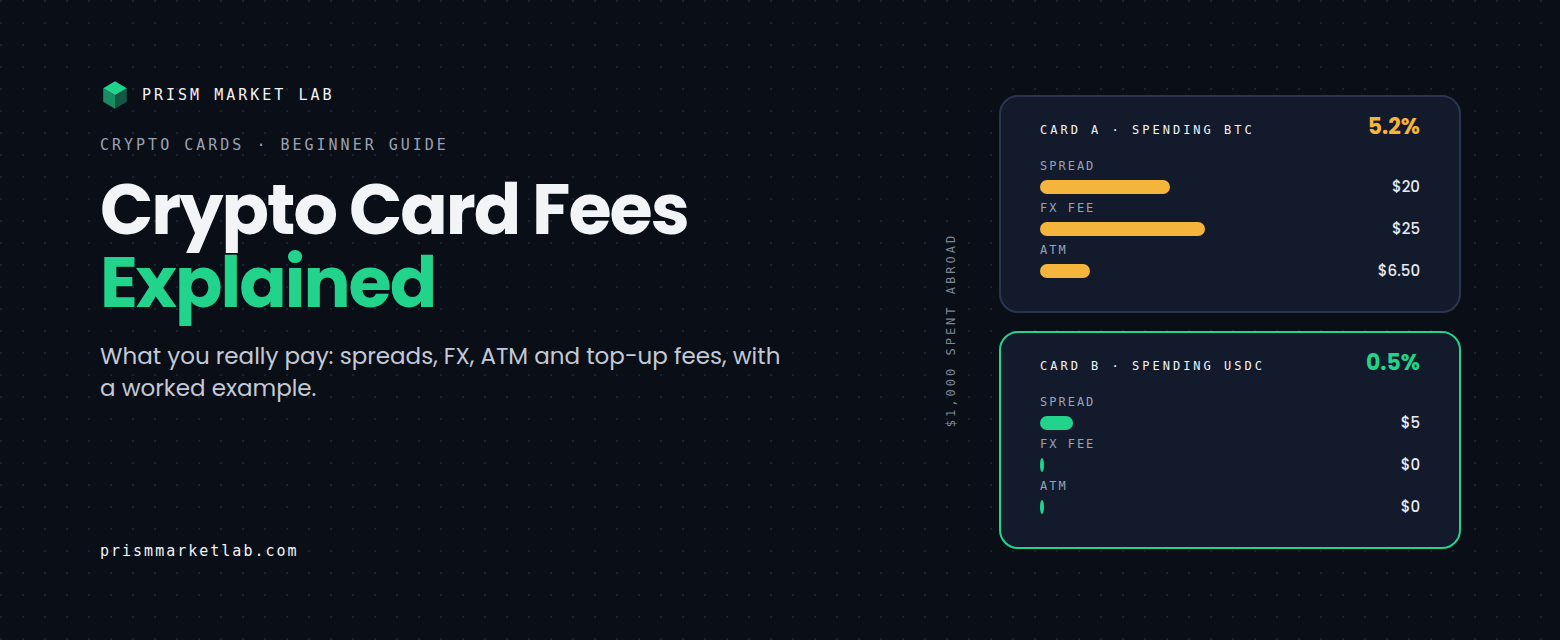
Let's compare two simple setups for spending $1,000 abroad (illustrative numbers):
Card A, spending Bitcoin:
- Conversion spread: 2% → $20
- FX fee: 2.5% → $25
- One ATM withdrawal of $200 at 2% + $2.50 → $6.50
- Total: about $51.50, or 5.2% of your spending
Card B, spending a stablecoin:
- Conversion spread: 0.5% → $5
- FX fee: 0% → $0
- One ATM withdrawal within the free allowance → $0
- Total: about $5, or 0.5% of your spending
Same trip, ten times the cost. The headline "no annual fee" was true for both cards.
How Stablecoins Lower Your Costs
When you spend a stablecoin like USDC, the card is converting a digital dollar into a regular dollar. That's a much simpler conversion than selling Bitcoin, so spreads are usually smaller. Some providers charge little or nothing to spend stablecoins. As a bonus, spending stablecoins also creates almost no taxable gain (see Do You Pay Tax When You Spend Crypto With a Card?).
How to Calculate Your All-in Cost
Before choosing a card, take your typical month and add it up:
- Monthly spending × conversion spread
- Spending in other currencies × FX fee
- Number of ATM withdrawals × ATM fee (after the free allowance)
- Top-ups per month × top-up and network fees
- Monthly or annual card fee (divide annual by 12)
- Minus real cashback, valued in the token's current price
Divide the total by your monthly spending. That's your true cost per $100. Compare it with your normal bank card. 8 Ways to Pay Less:
- Spend stablecoins instead of volatile crypto.
- Pick a card with 0% or low FX fees if you travel or shop in other currencies.
- Plan ATM withdrawals: take larger, fewer amounts within your free allowance.
- Top up on low-fee networks and in larger, less frequent amounts.
- Always pay in the local currency when a terminal asks; the "pay in your home currency" option often adds a hidden markup.
- Avoid weekend currency exchanges if your provider adds weekend markups.
- Value rewards honestly: count cashback at its current price, not its promise.
- Recheck fees every few months. Card fees change often, sometimes with little notice.
Do crypto cards have hidden fees?
Often, yes. The conversion spread is built into the exchange rate rather than shown as a fee, and FX markups can be easy to miss.
What is a conversion spread?
It's the difference between the market price of your crypto and the rate the card gives you when it sells it to pay for a purchase.
Are crypto cards cheaper than bank cards?
Sometimes. Stablecoin cards with low FX fees can be cheaper abroad, but cards that spend volatile crypto with high spreads can cost more.
Is it cheaper to spend stablecoins?
Usually. Spreads on stablecoins tend to be lower, and you avoid price swings and most taxable gains.
How do I find a card's real fees?
Read the fee schedule or cardholder agreement on the provider's official website, not just the ads, and recheck it regularly.
Bottom Line A crypto card's real cost is the sum of its spread, FX fee, ATM fees and top-up costs, minus genuine rewards. Spend stablecoins, choose low FX fees if you travel, plan your ATM use, and calculate your all-in cost before you commit.
This article is for information only and is not financial advice. Fees change often; always check the provider's current terms.