

What Is a Prop Firm? Funded Trader Challenges Explained
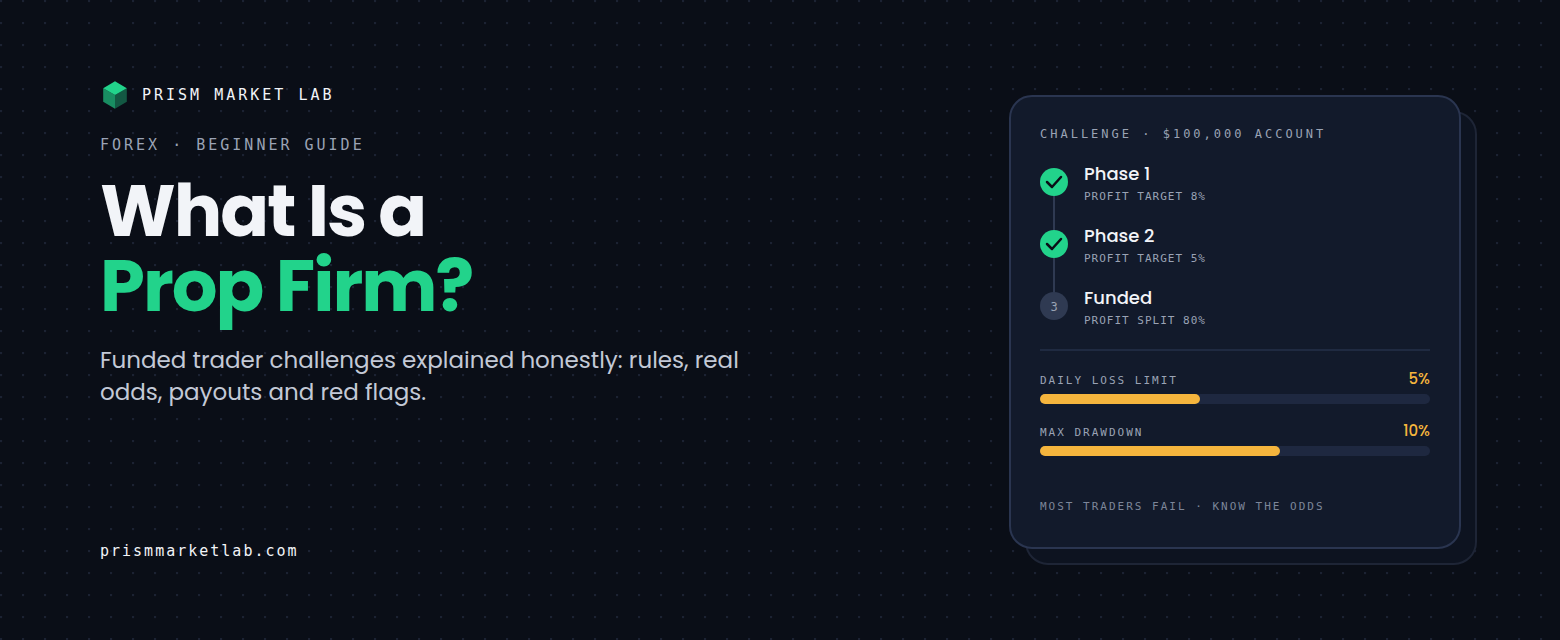
"Trade our $100,000 account and keep 80% of the profits" sounds amazing. Here's how prop firm challenges really work, how firms make money, what the pass and payout numbers look like, and how to avoid the risky ones.
A prop firm (proprietary trading firm) offers traders the chance to trade a large account, often $10,000 to $200,000, after passing a paid evaluation called a "challenge." If you pass and follow the rules, you keep a share of the profits, often 70–90%. But most traders fail the challenge, the fee is how many firms make their money, and most funded accounts are simulated rather than real market accounts. It can be a low-cost way to test your skills, as long as you understand the odds.
Key Takeaways
- You pay a fee to attempt a challenge; if you fail, you lose the fee.
- Only a small share of traders pass, and fewer receive payouts.
- The industry is mostly unregulated. Choose firms with a long, verifiable payout history.
What Is a Prop Firm?
Traditionally, "prop trading" meant a bank or trading company risking its own money in the markets with professional traders. Since around 2020, a new type of online prop firm has become popular: firms that sell evaluations to retail traders and promise to "fund" the ones who succeed. Today, when most people say "prop firm," they mean these online funded-trader programs, mostly for forex, indices, gold and futures, and increasingly crypto.
How Does a Prop Firm Challenge Work?
- Pick an account size, for example $50,000, and pay a one-time fee, often from under $100 to several hundred dollars depending on size.
- Pass Phase 1: reach a profit target (often 8–10%) without breaking the rules.
- Pass Phase 2: a second, usually easier target (often around 5%). Some firms offer one-step or "instant funding" options instead.
- Get a funded account: you trade the firm's account and request payouts on your profits.
- Keep a profit split: commonly 70–90% to you.
If you break a rule at any stage, the account is closed. You can usually buy a new challenge.
The Rules That Fail Most Traders
- Maximum daily loss: for example, you can't lose more than 5% in one day.
- Maximum total drawdown: for example, the account can't fall more than 10% from its starting or highest value. Some firms use a "trailing" drawdown that moves up as you profit.
- Minimum trading days: you must trade on a set number of days.
- News trading limits: many firms restrict trading around big economic releases.
- Consistency rules: no single day can make up too large a share of your profit.
- Banned strategies: such as copying other traders' accounts, exploiting price delays, or holding trades over weekends on some account types.
Read every rule before you pay. Many traders lose their account to a rule they didn't know about, not to a bad trade.
How Do Prop Firms Make Money?
This is the most important question. Most online prop firms earn their main income from challenge fees, not from trading profits. Because most traders fail, the fees from many failed attempts pay for the profit splits of the few who succeed. In addition, many "funded" accounts are simulated (demo) accounts. Your trades are tracked as if they were real, and the firm pays you from its own money. Some firms copy successful traders into real markets; others don't.
This isn't automatically a scam. It works like a paid skills test. But it means the firm's business depends on most people failing, so the rules are designed to be strict.
What Are the Real Pass and Payout Rates? Numbers vary by firm and aren't always public. One widely cited industry breakdown estimated that about 14% of traders pass challenges, and only around 45% of those reach an actual payout, about 7% of all traders (BabyPips)
Payouts are also concentrated. Blockchain-visible payouts across the ten largest firms reached $115.1 million in Q1 2026, with two firms accounting for about 70% of the total, according to a Finance Magnates FM Intelligence analysis reported by NexusFi. In other words, a few large firms do most of the paying.
Are Prop Firms Regulated?
Mostly not. Many prop firms operate as education or evaluation companies rather than brokers, so they fall outside traditional financial regulation in many countries. That has caused real problems: in February 2024, MetaQuotes, the maker of MetaTrader, restricted support for prop firms, and several firms closed or stopped payouts in the following period, including well-known names (BabyPips).
Regulators are paying more attention, especially to marketing claims and payout practices, and an industry group was formed in 2025 to create voluntary standards. But for now, your protection depends mostly on choosing a reputable firm.
Pros and Cons
Pros:
- You risk only the challenge fee, not your own large trading capital.
- Strict rules can teach discipline and risk management.
- Successful traders can earn more than they could with a small personal account.
Cons:
- Most traders fail and lose the fee, sometimes again and again.
- Rules can be complex and change.
- Payouts depend on the firm's financial health and honesty.
- Little regulation and few protections if a firm closes.
- Repeatedly buying challenges can become an expensive habit.
8 Red Flags When Choosing a Prop Firm
- No track record or a brand-new firm with huge promises.
- Unclear or changing rules, especially after you pay.
- Payout complaints in independent reviews and trader forums.
- Hidden company details: no clear owner, address or legal entity.
- "Guaranteed" funding or pass rates that sound too good.
- Aggressive discounts every week that create pressure to buy.
- Vague terms about what happens to your account if the firm closes.
- Fake-looking reviews: many five-star reviews posted at the same time.
How to Approach a Prop Firm Challenge Safely
- Practise on a free demo first until you're consistently profitable under the same rules.
- Start with a small account size to keep the fee low.
- Treat the fee as money you may lose. Set a limit on how many challenges you'll buy.
- Risk 0.5–1% per trade so you stay far from the drawdown limits.
- Track your stats and stop if you're failing repeatedly. That's information, not bad luck.
- Withdraw profits as soon as you're eligible.
Frequently Asked Questions
Are prop firms legit?
Some are established and pay traders regularly; others have closed or refused payouts. Research the firm's payout history before you buy a challenge.
Is the money in a funded account real?
Often not. Many funded accounts are simulated, and payouts come from the firm's own funds.
How hard is it to pass a prop firm challenge?
Hard. Industry estimates suggest only a minority pass, and even fewer get paid.
Do I have to pay tax on prop firm payouts?
Usually yes. How they're taxed depends on your country, so check with a tax adviser.
What's the best account size to start with?
The smallest one that fits your strategy. It keeps the cost of failing low while you learn the rules.
Bottom Line
Prop firms let you trade a large account for a small fee, but most traders fail, payouts are concentrated in a few firms, and regulation is limited. Treat a challenge as a paid test of your skills, choose an established firm, and manage risk as if your account depends on it, because it does. This article is for information only and is not financial advice. Trading involves significant risk of loss.